


The Very First Writing System
Seen as one of the most pivotal achievements in human history, the development of the Cuneiform writing system allowed for the creation of the very first examples of literature. Mostly known for being the very first written language itself (Sumerian, which is derived from Cuneiform), the name Cuneiform comes from the Latin word cuneus (meaning wedge), due to the wedge-shaped manner of writing. Using a reed stylus for writing, the wedges of the instrument are pressed into a clay tablet, creating imprints that represent pictures (known as pictograms).
The early forms of Cuneiform (referred to as proto-cuneiform) were mainly pictorial and straightforward, as shown in this example here:
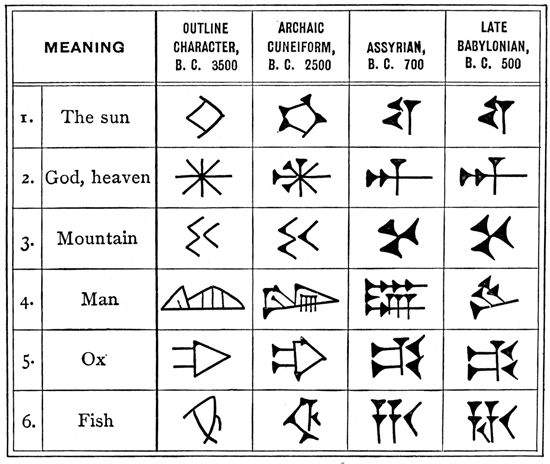
Often used for long-distance communication trade, early Cuneiform did not need to be sophistically composed simply because only the type and quality of a shipment, plus price, name, and location were needed. Developing in complexity throughout the Early Dynastic Period (2900-2334 BCE), more concepts of expression arose, in which the pictograms shown above earlier came to be replaced by phonograms as found in the city of Uruk (3200 BCE), which were symbols expressing sounds rather than pictures.

As Cuneiform continued to advance, the number of characters reduced from 1,000 to 600 in order to simplify what was written. Scribal schools began to arise, established to preserve and teach the craft of writing, and were operated out of private homes. Known as an edubba (House of Tablets), these schools developed and began to spread across the entirety of Sumer.
(For context, Sumer sat in the Southern region of ancient Mesopotamia, which is where modern-day Iraq and Kuwait are.)
It’s interesting to backtrack through the entirety of the human world, seeing where we first began writing, starting to communicate only through pictures, and leading into abstract concepts. The writing system of Cuneiform propelled the ways in which concepts were spread throughout Sumer, and rose to great influence (such as creating Semitic languages, such as Hebrew and Arabic). As Sumer thrived, yet another river civilization was in the midst of creating their own writing system: Hieroglyphics. You can take a guess where that might be.


Comments