


Punchcutting - Typing with Metal!
As brought up in my design classes, the spreading of mainstream type has been all thanks to the invention of the printing press, made famous by Johannes Gutenberg. With letters that were mounted on a metal press and arranged to fit the page of text, this invention made way for an expansion of literacy across Europe. Before the printing press, there was firstly process of punchcutting, where letters were outlined into one end of a steel bar. The manual process of this, even to the most experienced, was very long and averaged to make about one letter a day. Split into two different tools, making a punch-cut was composed of both a punch and a counter-punch. Referring to the large bar with the letter on it, the punch is the finished product, while the counter-punch imprints the letter onto the bar. Firstly, the punch has to be annealed (softened under heat), and the counter-punch must be hardened in order to give an accurate imprint.
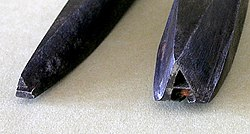
Counter-punches can also be used in several letters in a typeface, such as using to make the negative space with the letters “P” and “R”. Using this method also made typefaces more consistent. Finally, once punched, the outer form of the letter is smoothed with a file to create the final punch.
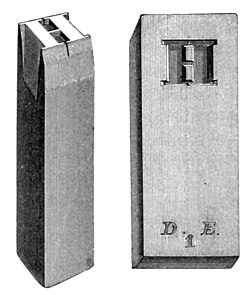
It’s admirable to see the work that went into creating printing technology back then, and has grown more convenient over time.
Hard to believe that creating the entire alphabet would take almost a month to make in this way!
Punchcutting advanced in the 1850s to the technology of electrotyping, which forms copper matrices around engravings of a letterform. An example is shown here, the electrotyped version being the copper beetle.


Comments